
Modern customer journeys rarely happen in a single place. Users interact with brands through websites, mobile apps, CRMs, payment providers, and offline touchpoints before converting. While analytics tools can capture part of this journey, they often fall short when it comes to offline events, backend actions, and cross-platform identity stitching.
This is where a Customer Data Platform (CDP) becomes valuable.
In this article, we’ll explore how to build a simple, cost-effective CDP using Server-Side Google Tag Manager (sGTM) and Stape Store. This approach allows you to centralize customer data, enrich events in real time, and send complete user profiles to your marketing and analytics platforms—without relying on expensive third-party CDP tools.
Why Build Your Own CDP?
Most CDPs solve two core problems:
- Centralizing customer data from multiple sources
- Creating a unified customer profile that can be reused across platforms
Prebuilt CDPs can be powerful, but they are often expensive, complex, and oversized for many use cases. If your primary goal is to merge online and offline data, enrich events, and control data flow, a server-side GTM–based CDP can be more than sufficient.
With sGTM acting as the processing layer and a database acting as storage, you can build a flexible system that grows with your needs.
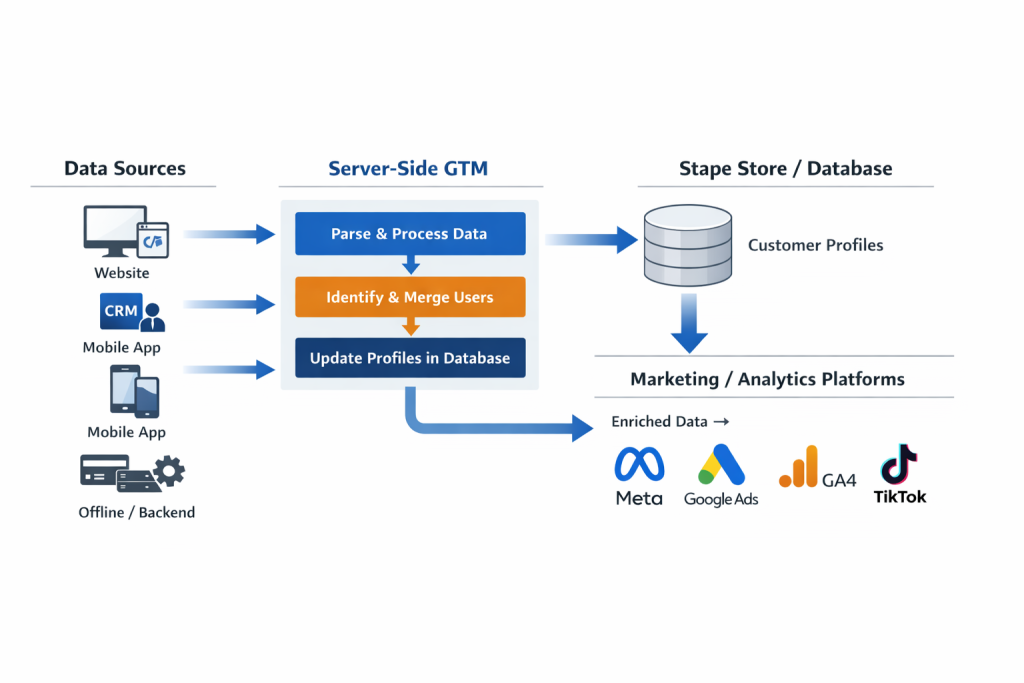
High-Level Architecture
At a high level, the setup looks like this:
- Data sources send events (online and offline)
- Server-side GTM receives, normalizes, and processes the data
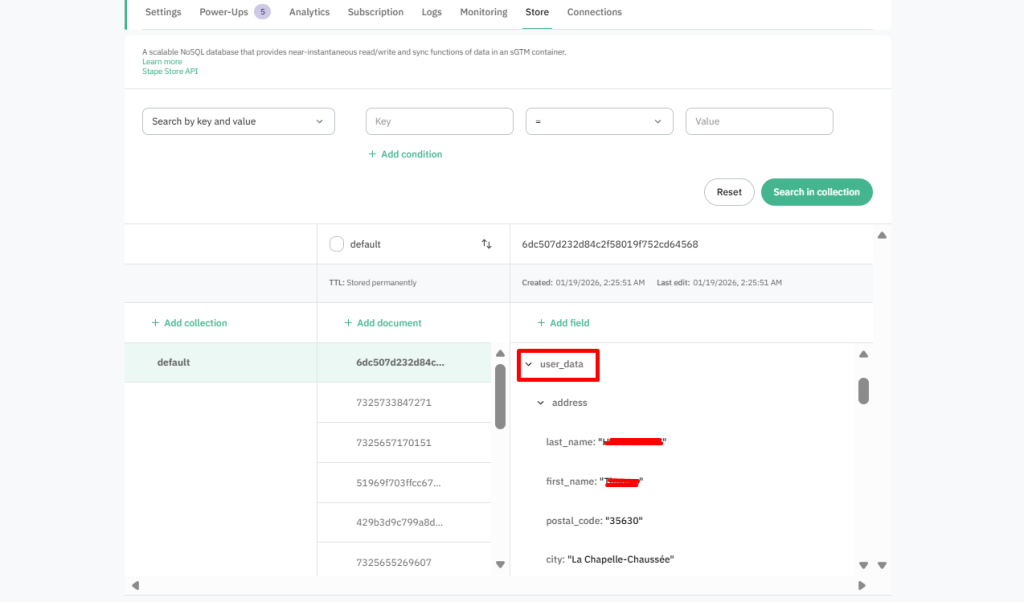
- Stape Store (or another database) stores customer profiles
- Vendors receive enriched events via server-to-server connections
Unlike traditional analytics setups, this architecture does not depend solely on browser execution.
What Data Can Be Ingested?
Server-side GTM can receive data from almost any source, including:
- Websites (via GA4 server-side tag or Data Tag)
- CRMs (HubSpot, Salesforce, Jira, etc.)
- CMS platforms (Shopify, WordPress, Magento,Wix, SquareSpce)
- Mobile apps and SDKs
- Payment processors (Stripe, Braintree, PayPal, Teachable, Plug & play )
- Custom backend systems via webhooks( Headless Store)
Core Components of the Setup
To build this CDP, you need:
- Server-Side Google Tag Manager container
- Database layer (Stape Store, Firestore, or Supabase)
- A reliable user identifier to merge events into profiles
Stape Store is often the simplest choice because it is built into the Stape ecosystem and requires no external infrastructure.
How Data Flows Through the System
Here is the simplified flow:
- A user performs an action (online or offline)
- The data source sends an event to sGTM
- A client (GA4, Measurement Protocol, or Data Client) parses the request
- sGTM checks whether the user already exists in the database
- Incoming data is merged with stored customer data
- The updated profile is saved back to the database
- Enriched events are sent to marketing or analytics platforms
The Importance of User Identification
Identity resolution is the most critical part of any CDP.
- Identified users: email address, internal user ID, CRM ID
- Anonymous users: server-generated ID based on IP, user agent, and other signals
Merging and Enriching User Data
Once a user identifier is established, sGTM can:
- Look up existing user records
- Fill missing fields using stored data
- Overwrite outdated values with newer ones
- Create new profiles when no match is found
Sending Enriched Data to Vendors
After processing, enriched events can be forwarded to platforms such as:
- Meta (CAPI)
- Google Ads
- GA4
- TikTok
- Other server-side APIs
Server-to-server connections make the data more reliable and less affected by browser limitations.
Debugging and Observability
Debugging server-side setups can be challenging, especially with offline data. Tools include:
- sGTM preview mode
- Request and response logs
- Logger tags
- Server headers for request tracing
Proper logging ensures no data silently fails.
Example Use Case: Enriching Facebook event match quality score for PageView, ViewContent, AddToCart, InitiateCheckout Event with Purchase user Data for returning user
A common scenario is enriching early-funnel events with later-purchased attributes:
- Write purchase data to the database
- Link it to a user identifier
- Restore selected fields during subsequent events
Final Thoughts
Building a custom CDP with server-side GTM and Stape Store is a practical way to regain control over your customer data. It centralizes events, stitches identities, enriches data, and sends high-quality signals to your marketing stack—without the overhead of a full-scale CDP product.
For teams already using server-side GTM, this approach is often the natural next step toward more advanced data ownership and activation.