
If you are running ads on Facebook and Instagram ads, accurate conversion tracking is non-negotiable. One metric that plays a decisive role in how well your campaigns perform—but is often overlooked—is Event Match Quality (EMQ).
Event Match Quality measures how effectively Meta can associate the events you send (such as purchases or leads) with real users. Strong match quality improves attribution, optimization, and overall ad efficiency. This article explains what EMQ is, what influences it, and how to improve it responsibly.
What Is Event Match Quality?
Event Match Quality is Meta’s internal scoring system that evaluates the completeness and reliability of user identifiers sent with each event. The score ranges from 0 to 10 and is calculated separately for each event type (PageView, AddToCart, Purchase, etc.).
In simple terms, EMQ answers this question:
How confident is Meta that this event belongs to a known user?
The more confidently Meta can identify the user behind an event, the better it can attribute conversions and optimize ad delivery.
Why Event Match Quality Matters
Improving Event Match Quality has a direct impact on campaign outcomes:
- Stronger attribution
Conversions are more accurately credited to ads, improving reporting reliability. - Better optimization
Meta’s algorithms learn faster when events are clearly tied to users. - Improved efficiency
More accurate signals typically lead to lower CPAs and better ROAS.
In short, higher EMQ means Meta understands who converted, not just that a conversion happened.
What Data Influences Event Match Quality?
Event Match Quality depends entirely on the user identifiers included with an event. These identifiers help Meta match server or browser events to user profiles.
Meta evaluates parameters with different priority levels.
User Data Parameters and Priority
| Parameter Type | Examples | Priority |
| Strong identifiers | Email, Click ID | High |
| Persistent identifiers | External ID, Phone number, Login ID | Medium |
| Demographic signals | Birthdate, Country | Medium |
| Supplemental data | First name, Last name, City, ZIP code | Low |
The presence of high- and medium-priority parameters has the greatest impact on EMQ.
Technical Identifiers: _fbp and _fbc
Two parameters are particularly important in Meta tracking setups:
_fbp (Browser Identifier)
- Created automatically by the Meta Pixel
- Stored as a first-party cookie
- Identifies a browser instance over time
_fbc (Ad Click Identifier)
- Created when a user clicks a Facebook or Instagram ad
- Derived from the fbclid URL parameter
- Only available for traffic originating from Meta ads
Not all events will include _fbc, and that is expected behavior.
How Event Match Quality Is Calculated
Meta calculates EMQ using recent event data, typically from the last 48 hours. The score reflects:
- Which identifiers were sent
- How consistently they were included
- Whether events could be matched to Meta user profiles
For example:
- PageView events often have lower scores because limited user data is available.
- Purchase or Lead events usually score higher when enriched with email, phone, or external IDs.
Achieving a perfect score of 10 is uncommon and not required for strong performance.
Common User Data Parameters You Can Send
Core Matching Parameters
| Parameter | Description |
| em | Email address (hashed) |
| ph | Phone number (hashed, E.164 format) |
| external_id | Internal user or CRM ID |
| fbp | Browser identifier |
| fbc | Facebook click identifier |
| client_ip_address | User IP address |
| client_user_agent | Browser user agent |
Supplemental Parameters
| Parameter | Description |
| fn | First name (hashed) |
| ln | Last name (hashed) |
| ct | City |
| st | State or region |
| zp | ZIP or postal code |
| country | ISO country code |
| db | Date of birth (YYYYMMDD) |
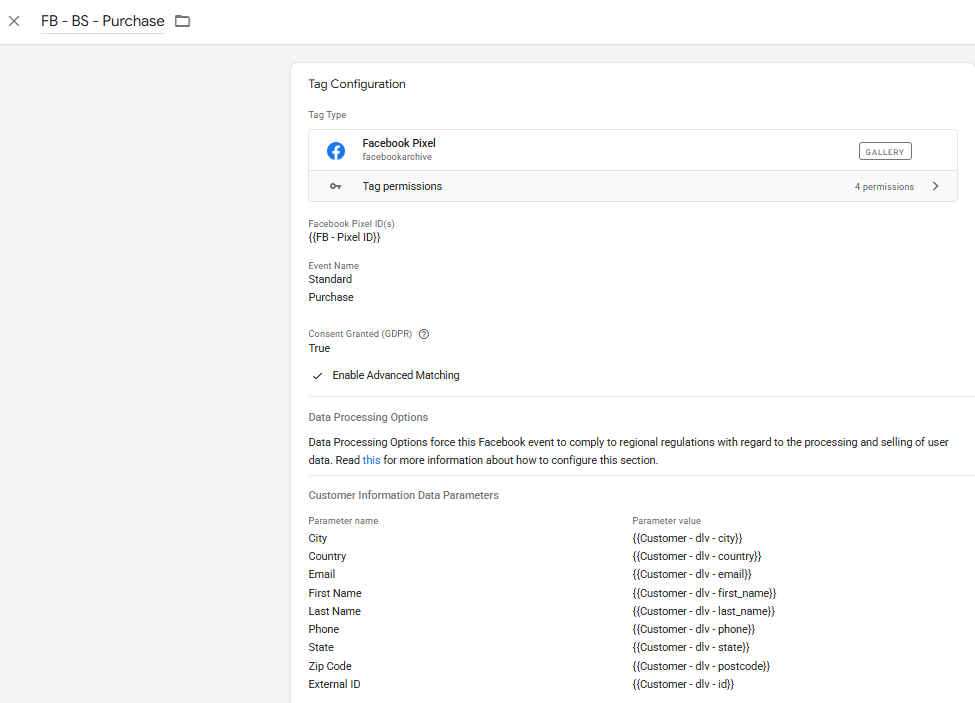
Meta Pixel Advanced Mathcing Conifigurations
Meta Conversion API or Server Side Advanced Mathcing Conifigurations ( Note: GA4 template using for sending data client to server only)
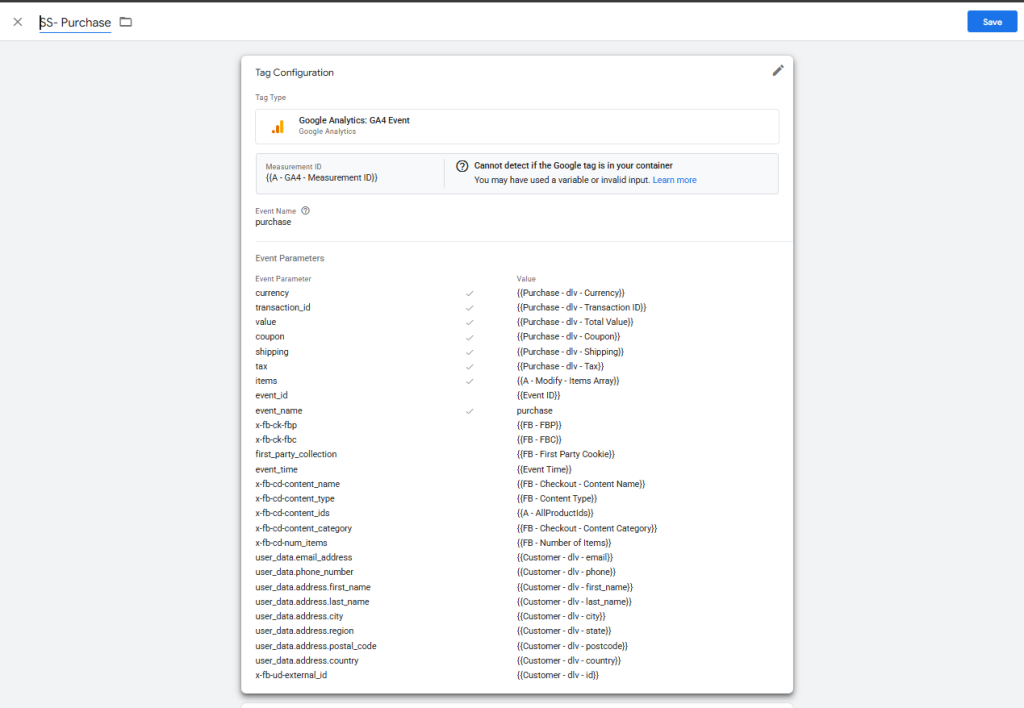
While supplemental parameters help, they should never replace core identifiers.
Privacy and Compliance Considerations
Improving Event Match Quality must always align with privacy regulations such as GDPR and CCPA.
Key principles:
- Obtain explicit user consent before tracking
- Collect only data that serves a clear purpose
- Hash personal identifiers before transmission
- Clearly document data usage in your privacy policy
- Regularly review compliance as regulations evolve
A privacy-first approach builds trust while preserving measurement quality.
Practical Ways to Improve Event Match Quality
- Use a structured data layer
A reliable data layer ensures user data remains available across events. - Send identifiers consistently
If you capture an email or phone number once, reuse it for future events (with consent). - Monitor event diagnostics
Errors or malformed events reduce EMQ and should be resolved promptly. - Store first-party data responsibly
Persist user identifiers securely to enrich later events. - Enrich server-side events
Combining first-party data with server tracking significantly improves match rates. - Validate events regularly
Review match quality trends in Meta Events Manager to catch regressions early.
What Is a “Good” Event Match Quality Score?
There is no universal benchmark, but general guidance is:
- Below 3 – Investigate potential issues
- 4–6 – Healthy and common for most setups
- 7+ – Strong enrichment and matching
A score around 6 is already very effective. Chasing a perfect score often leads to unnecessary data collection without meaningful performance gains.
Final Thoughts
Event Match Quality is not just a technical metric—it directly influences how well your Meta campaigns learn, optimize, and scale. By sending accurate, consented user data and maintaining clean event implementations, you enable better attribution without compromising privacy.
Focus on consistency, data quality, and compliance. When those fundamentals are in place, strong Event Match Quality follows naturally.