
Server-side GTM is only half the story. Here’s what you’re leaving on the table without data enrichment.
The Problem With Most sGTM Setups
I’ve audited a lot of server-side GTM setups. Most of them are doing the basics right — GA4 event forwarding, Meta CAPI, Google Ads Enhanced Conversions. The tagging is clean. The data is flowing.
But almost none of them are using enrichment.
That’s the gap. And it’s a big one.
Here’s what most setups actually look like when you inspect the event data reaching Meta or Google:
- Purchase event → email ✔, phone ✔, name ✔
- Add to cart event → nothing
- Page view event → nothing
- View item event → nothing
So your bottom-funnel events land with strong signals. Everything above that? Weak, anonymous, and effectively wasted as far as your ad platforms are concerned.
The fix isn’t more tags. It’s enrichment.
What the Stape Enricher Actually Does
The Stape Enricher is a power-up built into your sGTM infrastructure on Stape. The core mechanic is simple:
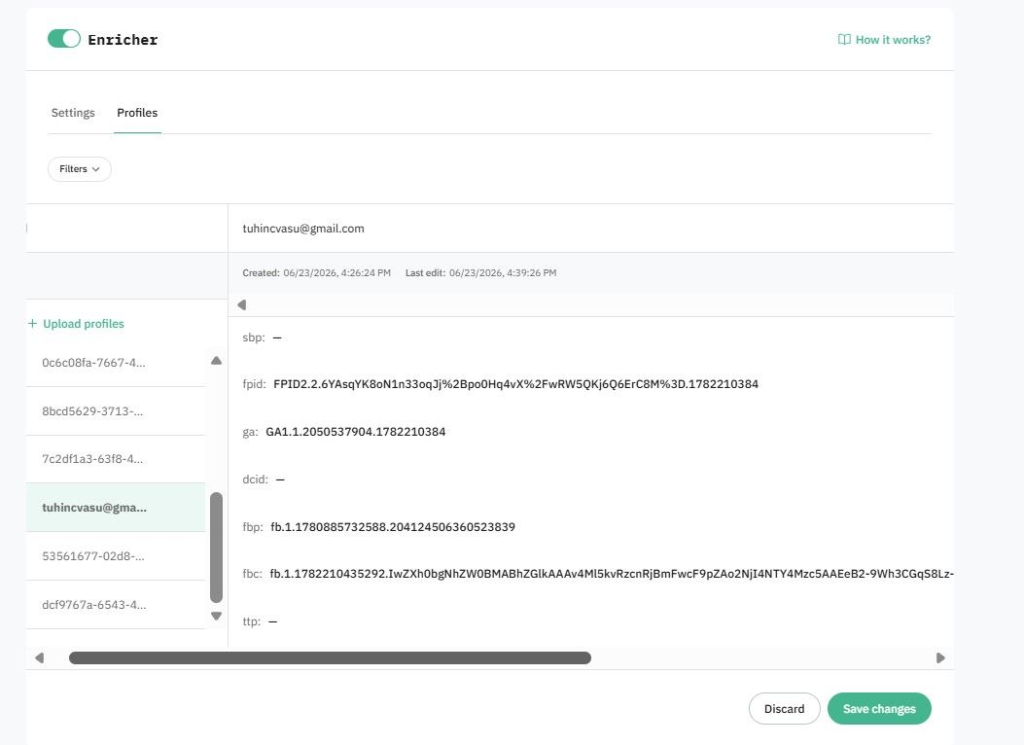
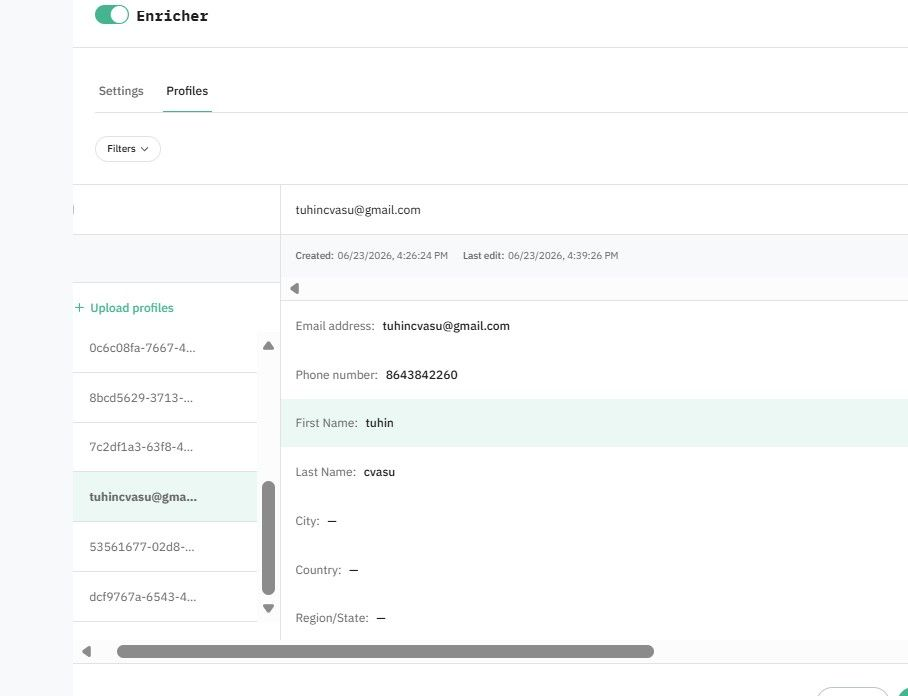
When a user sends an event with a known identifier — email, phone, or a user ID from your CRM — the Enricher stores that data in a persistent user profile. When the same user fires a later event, even from a different device or browser, the Enricher looks them up and appends the stored identifiers to the outgoing hit before it reaches Meta or Google.
| 💡 No extra pipeline. No new vendor contract. No CDP subscription. It lives inside Stape, alongside your existing sGTM container. It’s a toggle. |
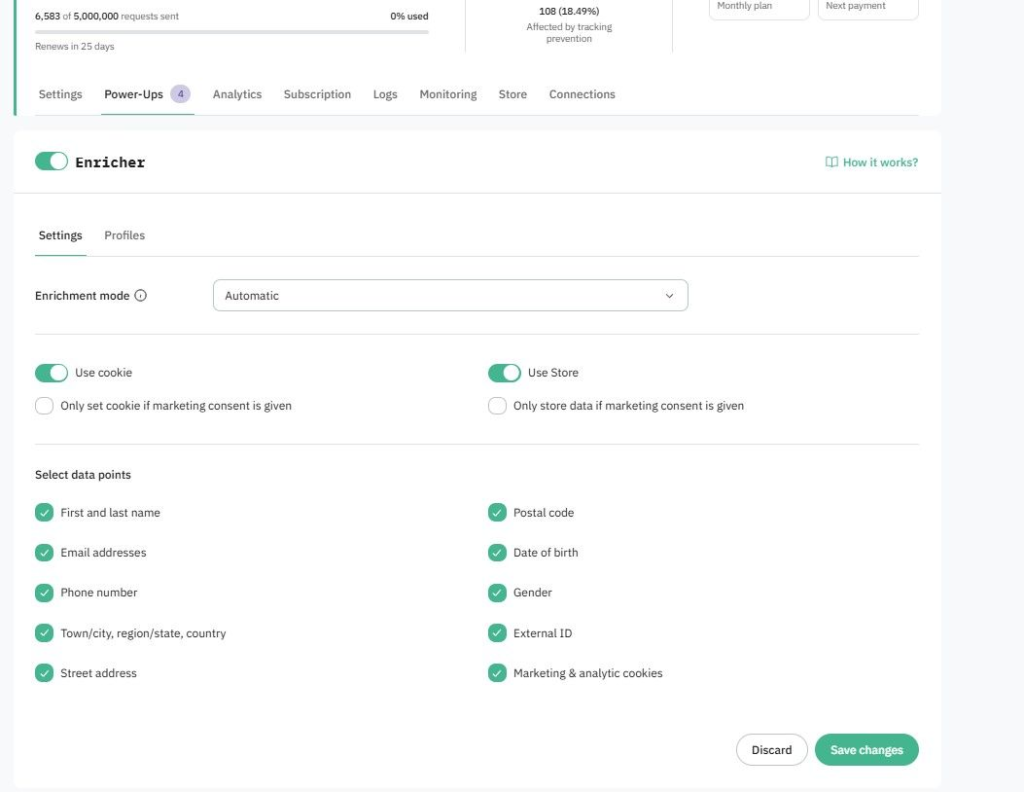
What it stores per user (all consent-gated):
- Email address and phone number
- First and last name
- Full address: street, city, region, country, postal code
- Date of birth and gender
- External ID (your CRM or internal user ID)
- Marketing and analytic cookies
How It Transforms Meta CAPI Performance
The Event Match Quality Problem
Meta grades every event you send on Event Match Quality (EMQ) — a score based on how many identifying signals were included. High EMQ means Meta can confidently tie the event to a real Facebook profile. Low EMQ means the event is nearly useless for attribution and audience building.
Without enrichment, your EMQ looks like this: excellent on purchase, poor on everything else. The Enricher changes this across your entire funnel.
What Changes in Practice
- Page views, view_item, add_to_cart, initiate_checkout — all enriched with stored email, phone, and name. Your ToFu events now carry the same identifying power as your purchase events. Higher EMQ across all events
- You’re building lists from identified users, not anonymous cookie pools. Smaller in size, far more accurate in targeting. Sharper remarketing audiences
- If a Meta impression on day one influenced a conversion on day seven, the Enricher connects both events to the same identified user. More of your assisted conversions get credited back to the campaign that drove them. Better attribution on assisted conversions
- A user who browses on mobile, returns on desktop three days later, and converts is currently three separate anonymous sessions in most setups. With enrichment, they’re one person. Cross-session recognition
| Real example: After enabling the Enricher for an e-commerce client, their Meta page_view EMQ went from “Poor” to “Good” within a week. Remarketing CPAs dropped because Meta was now targeting real, identified users instead of guessing based on browser signals. |
How It Transforms Google Ads Enhanced Conversions
Why GCLID Alone Is No Longer Enough
Enhanced Conversions work by sending a hashed email alongside your conversion event. Google matches it against signed-in Google accounts to tie the conversion back to the original ad click, even when the GCLID is missing, expired, or blocked.
The problem: GCLID-based attribution is increasingly unreliable. iOS privacy changes, ad blockers, cross-device journeys, and browser-level restrictions all erode it. Enhanced Conversions exist to fill that gap — but only if you’re consistently sending the hashed email. Most setups aren’t.
What Changes in Practice
- The Enricher stores the identifier the first time it sees the user. Every conversion event after that carries it automatically, regardless of whether the user typed their email at checkout again. Consistent hashed email on every conversion event
- User clicks a Google Search ad on mobile, researches on desktop, converts on a tablet. Previously: three separate anonymous sessions. With enrichment: one attributable journey. Enhanced Conversions catch the conversion and match it back to the original click. Cross-device conversions finally close the loop
- Target CPA and Target ROAS strategies optimize on conversion data. More matched conversions means better signals, better bid decisions, and lower CPAs over time. It compounds. Better Smart Bidding signals
- If you’re importing CRM conversions — phone sales, in-store purchases, closed deals — richer identifiers on your server-side events mean more imports find a match in Google’s system. More matched offline conversions means a truer picture of campaign performance. Higher match rates on offline conversion imports
| The Enricher doesn’t change your tagging architecture. It sits inside your existing Stape infrastructure and makes every event you’re already firing materially better. |
The Preloading Advantage: Don’t Start From Zero
The Enricher works best when it’s not starting from scratch.
Stape lets you import your existing customer base — hashed emails, phone numbers, user IDs — directly into the Enricher’s data store. That means returning customers are recognized immediately, from their very first event in a new session, without needing to fire a login event or pass an identifier in real time first.
For e-commerce clients with established databases, this is significant. A returning customer who lands on the homepage fires a page_view that already carries their stored email. That event hits Meta with a high EMQ score before they’ve even added anything to cart.
The Combined Effect: A Near-Closed Attribution Loop
Running Meta CAPI and Enhanced Conversions simultaneously through an enriched sGTM setup creates something close to a closed-loop attribution system for the platforms that matter most.
- Every event — from first page view to purchase — carries the best available identifying information
- Both platforms receive richer signals
- Both attribution models improve
- Both bidding algorithms optimize on better data
- Cross-device and cross-session journeys are connected, not fragmented
For clients running meaningful Meta and Google Ads spend, the match quality improvement alone typically justifies enabling it within the first week.
One Non-Negotiable: Consent First
The Enricher stores and reuses personal data. That means it only runs on users who have given explicit consent for data processing and tracking under your privacy policy.
This isn’t optional. In practice, your enrichment logic needs to be gated behind your Consent Mode implementation. If a user hasn’t opted in: no storage, no enrichment, no exceptions. Stape’s setup accommodates this with built-in consent checks:
- Only set cookie if marketing consent is given
- Only store data if marketing consent is given
Both toggles are right there in the Enricher settings. Make sure they’re on.
How Long Does This Take to Set Up?
For a client already on Stape’s sGTM infrastructure, the Enricher is genuinely close to a toggle. Here’s the setup flow:
- Enable the Enricher in your Stape dashboard under Power-Ups
- Configure which data points to store and look up (email, phone, name, address, external ID)
- Connect it to your sGTM container
- If preloading: do a one-time customer base import via Stape Store
- Verify your consent mode gates are active
I’ve been enabling this for all eligible clients as a standard part of sGTM setup now. If you’re on sGTM and haven’t turned this on, you’re doing the hard part and leaving the most valuable capability on the table.
| 💡 Turn it on. Your match quality scores will thank you within the first week. |