
I was reviewing a GA4 property for a client running Google Ads remarketing campaigns when I asked a simple question:
“Which audiences are you actively using?”
The marketing team opened the Audiences section.
There were 27 audiences.
Nobody could explain why half of them existed.
Some had been created by a former agency. Others were built years ago around campaigns that no longer ran. A few had never accumulated enough users to be useful. Several overlapped heavily with each other.
Technically, nothing was broken.
Audiences were populating.
Campaigns were running.
But nobody knew whether the audiences reflected the way the business actually operated today.
This happens more often than you’d think.
Audiences tend to accumulate over time. Teams launch campaigns, create segments, test ideas, and move on. Months later, the audience list becomes cluttered with outdated definitions that no longer support business goals.
That’s why reviewing audiences is an important part of every GA4 audit.
How GA Auditor Helps
Audience issues rarely generate alerts.
GA4 won’t tell you:
“You haven’t used this audience in two years.”
or
“This audience no longer aligns with your marketing strategy.”
Audiences continue to exist quietly in the background.
GA Auditor reviews audience configurations as part of its 150+ point GA4 audit checklist, helping organizations determine whether their audiences are relevant, actively used, and aligned with current business objectives.
The goal isn’t to create more audiences.
It’s to create audiences that are useful.
Why Audiences Matter
Audiences influence far more than many businesses realize.
They can impact:
- Google Ads remarketing campaigns.
- Audience-based bidding strategies.
- Personalized messaging.
- Customer segmentation.
- Reporting and analysis.
- User lifecycle strategies.
- Campaign efficiency.
Poor audience management doesn’t necessarily stop campaigns from running.
It simply makes them less effective.
What Are Audiences in GA4?
Audiences allow you to group users based on shared characteristics or behaviors.
For example:
You can create audiences for users who:
- Viewed a product but didn’t purchase.
- Started checkout but abandoned the process.
- Submitted a lead form.
- Returned multiple times.
- Purchased a specific product category.
- Engaged with particular content.
These audiences can then be used across Google’s advertising ecosystem.
When designed thoughtfully, they become powerful marketing assets.
When ignored, they become digital clutter.
Common Audience Issues Found During Audits
Nobody Knows Why the Audience Exists
This is the most common finding.
I ask:
“Why was this audience created?”
The answer is often:
“I think our old agency built it.”
That may have been a good reason at the time.
It doesn’t necessarily mean it’s still valuable.
Audiences No Longer Match Business Goals
Businesses evolve.
Products change.
Target markets shift.
Audience definitions often stay exactly the same.
Audiences Are Too Broad
Some audiences become so large that they offer little strategic value.
For example:
- All users.
- All visitors.
- Everyone except purchasers.
Large audiences aren’t inherently bad.
They simply aren’t always useful.
Audiences Are Too Narrow
The opposite problem also occurs.
Audience conditions become so restrictive that they rarely populate.
Campaigns never use them effectively.
Overlapping Audiences Create Confusion
Multiple audiences may target nearly identical users.
Teams struggle to understand:
- Which audience should be used?
- Which audience performs best?
- Whether audiences compete against each other.
Audiences Exist but Aren’t Used
This is surprisingly common.
Businesses invest time building audiences.
Nobody activates them in campaigns.
How to Audit Audiences in GA4
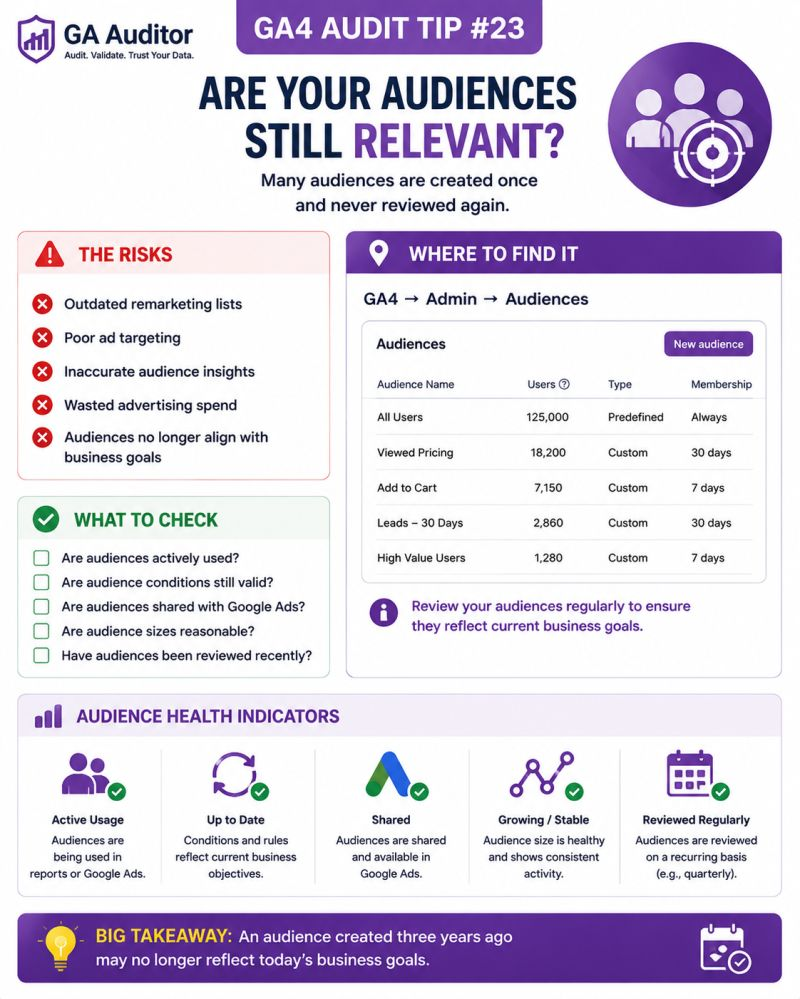
Navigate to:
Admin → Audiences
Review each audience individually.
Ask:
- Why does this audience exist?
- Is it still relevant?
- Is it actively used?
- Does it support current business goals?
- Would anyone notice if it disappeared?
If nobody can answer these questions confidently, the audience deserves attention.
Questions Worth Asking During an Audit
These conversations often reveal opportunities to simplify and improve.
- Which audiences support active campaigns?
- Which audiences influence budget allocation?
- Which audiences are no longer needed?
- Have customer behaviors changed?
- Have product offerings evolved?
- Does leadership understand the segmentation strategy?
Audience reviews aren’t just technical exercises.
They’re marketing strategy discussions.
Signs Your Audience Strategy Needs Attention
A review may be worthwhile if:
- The audience list feels cluttered.
- Nobody remembers creating certain audiences.
- Campaign teams avoid using audiences.
- Audience sizes look unusually small.
- Multiple audiences appear redundant.
- The business has evolved significantly.
- Agencies have changed over time.
None of these automatically indicate a problem.
But they often indicate an opportunity.
Reviewing Audience Sharing
If you’re using Google Ads, don’t stop at the audience definitions themselves.
Also ask:
- Are audiences shared successfully?
- Are they populating?
- Are they eligible for campaigns?
- Are they actively being used?
A perfectly designed audience has limited value if it never leaves GA4.
Best Practices
A few habits can make audience management much easier.
- Document why each audience exists.
- Assign ownership responsibilities.
- Review audiences quarterly.
- Remove outdated definitions.
- Consolidate overlapping audiences.
- Align audiences with business objectives.
- Coordinate with paid media teams.
- Include audience reviews in recurring audits.
The strongest audience strategies are usually the simplest.
Audience Audit Checklist
Use this checklist during your next review:
□ Review all existing audiences.
□ Document the purpose of each audience.
□ Identify unused audiences.
□ Review audience sizes.
□ Remove outdated audiences.
□ Consolidate overlapping definitions.
□ Validate audience sharing.
□ Confirm campaign usage.
□ Assign ownership responsibilities.
□ Schedule quarterly audience reviews.
Wrapping Up
I’ve yet to meet a business that suffers because it has too few irrelevant audiences.
I have met plenty that struggle because their audience strategy quietly became disconnected from reality.
Audiences should evolve as your business evolves.
They should reflect the customers you’re trying to reach today, not the campaigns you ran three years ago.
A quick audience review won’t instantly improve campaign performance.
But it will help ensure that your targeting strategy remains intentional instead of accidental.
Because good marketing isn’t just about reaching more people.
It’s about reaching the right people at the right time with the right message.