
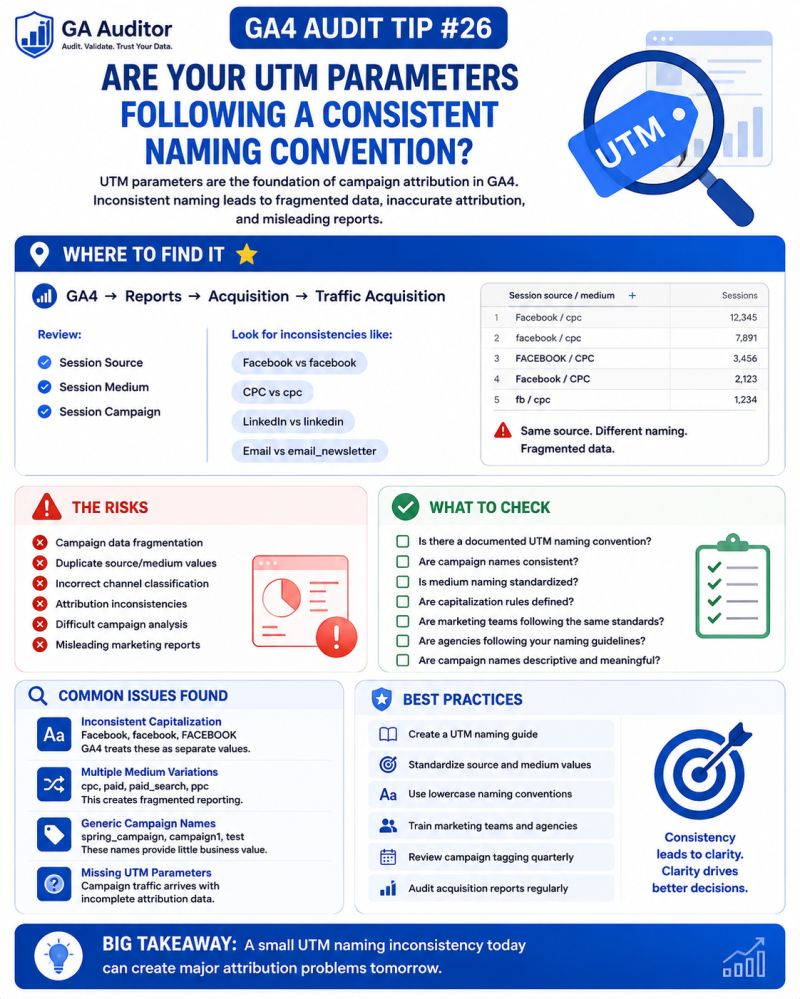
I was reviewing acquisition reports with a client when someone from the marketing team asked:
“Why do we have three different Facebook campaigns with exactly the same name?”
At first, everyone assumed it was a reporting bug.
Then we looked a little closer.
The campaigns weren’t actually the same.
One used:
utm_source=Facebook
Another used:
utm_source=facebook
A third used:
utm_source=FACEBOOK
GA4 treated them as three completely different sources.
The same thing had happened with email campaigns.
And paid search campaigns.
And affiliate campaigns.
Nothing was broken.
GA4 was simply reporting exactly what it had been given.
This is one of the most common data quality issues I find during audits. Businesses spend thousands of dollars on marketing campaigns but never establish a clear UTM naming standard.
The result isn’t missing data.
It’s messy data.
And messy data makes it much harder to understand what’s actually driving performance.
How GA Auditor Helps
UTM problems rarely trigger alerts.
Traffic appears in acquisition reports.
Campaigns continue generating conversions.
Dashboards update every day.
The issue usually surfaces when someone tries to answer questions like:
- Which campaigns performed best?
- Which channels drove revenue?
- How did email compare to paid social?
- Why don’t our reports make sense?
GA Auditor reviews campaign tagging practices as part of its 150+ point GA4 audit checklist, helping organizations identify inconsistent naming conventions, fragmented reporting, and attribution issues before they influence important decisions.
The objective isn’t simply to collect campaign data.
It’s to make that data usable.
Why UTM Naming Matters
UTM parameters tell GA4 where visitors came from.
They help answer questions such as:
- Which campaigns generated traffic?
- Which channels influenced conversions?
- Which partners drove results?
- Which marketing initiatives deserve more investment?
Without consistent naming conventions, acquisition reporting becomes fragmented.
Imagine trying to evaluate email performance when campaigns are tagged as:
- newsletter
- email_campaign
Technically, all of those campaigns may represent the same channel.
GA4 doesn’t know that.
It reports them separately.
A Quick Refresher on UTM Parameters
The most common UTM parameters include:
utm_source
Identifies where the traffic originated.
Examples:
- newsletter
utm_medium
Describes the marketing medium.
Examples:
- cpc
- paid_social
- affiliate
utm_campaign
Identifies the specific campaign.
Examples:
- spring_sale_2026
- black_friday_offer
- webinar_launch
utm_content
Often used to differentiate creative variations.
Examples:
- hero_banner
- text_ad
- button_version_a
utm_term
Primarily used for paid search keywords.
Not every organization uses every parameter.
But consistency matters regardless of which ones you choose.
Common Issues Found During Audits
Inconsistent Capitalization
This is probably the most common issue.
Examples include:
Facebook
facebook
FACEBOOK
GA4 interprets these as separate values.
Reporting quickly becomes fragmented.
Multiple Medium Definitions
I often see variations such as:
cpc
paid
paid_search
ppc
Teams may understand what they mean.
GA4 doesn’t consolidate them automatically.
Generic Campaign Names
Examples include:
campaign1
summer
test
launch
Months later, nobody remembers what they represented.
The data loses context.
Different Teams Use Different Standards
Marketing teams.
Agencies.
Freelancers.
Regional offices.
Everyone creates campaigns slightly differently.
Eventually, acquisition reports become difficult to trust.
Missing UTM Parameters
Sometimes campaigns launch without any tagging at all.
Traffic still arrives.
Attribution suffers.
How to Audit UTM Naming in GA4
Start by reviewing acquisition reports.
Navigate to:
Reports → Acquisition → Traffic Acquisition
Review dimensions such as:
- Session Source
- Session Medium
- Session Campaign
Look for patterns.
Ask yourself:
- Are similar channels appearing multiple times?
- Do naming conventions look intentional?
- Are there obvious inconsistencies?
- Would a new team member understand these names?
If the answer is no, a cleanup effort may be worthwhile.
Questions Worth Asking During an Audit
These conversations often reveal the root cause of attribution problems.
- Is there a documented UTM standard?
- Who creates campaign URLs?
- Do agencies follow the same guidelines?
- Are naming conventions reviewed?
- How are offline campaigns tagged?
- Does leadership trust acquisition reports?
In many cases, the issue isn’t technical.
It’s operational.
Signs Your UTM Strategy Needs Attention
A review may be worthwhile if:
- Facebook appears multiple times in reports.
- Email performance is fragmented.
- Campaign names are difficult to understand.
- Agencies manage campaigns independently.
- Attribution reports create confusion.
- Teams export reports and manually clean them.
- Nobody can explain the naming convention.
None of these automatically indicate a serious issue.
But they almost always reveal an opportunity to improve reporting quality.
Best Practices
A few simple habits can dramatically improve campaign reporting.
- Standardize UTM naming conventions.
- Use lowercase values consistently.
- Document approved sources and mediums.
- Create meaningful campaign names.
- Train internal teams and agencies.
- Review acquisition reports regularly.
- Include UTM governance in onboarding processes.
- Audit campaign tagging quarterly.
Small improvements in tagging often produce significant improvements in reporting clarity.
UTM Naming Audit Checklist
Use this checklist during your next review:
□ Review Session Source reports.
□ Review Session Medium reports.
□ Review Session Campaign reports.
□ Identify capitalization inconsistencies.
□ Standardize source naming conventions.
□ Standardize medium naming conventions.
□ Review campaign naming structures.
□ Document UTM standards.
□ Train internal teams and agencies.
□ Include UTM reviews in recurring audits.
Wrapping Up
I’ve never met a marketing team that intentionally wanted messy acquisition reports.
The problem is that UTM conventions rarely break overnight.
They deteriorate gradually.
A campaign launches quickly.
An agency uses its own naming system.
Someone forgets a parameter.
Months later, everyone spends hours trying to clean reports that could have been accurate from the beginning.
The good news is that fixing UTM governance doesn’t require new tools or expensive technology.
It simply requires consistency.
Because the difference between useful attribution and frustrating attribution often comes down to something as simple as agreeing whether it’s called:
Facebook, facebook, or FACEBOOK.